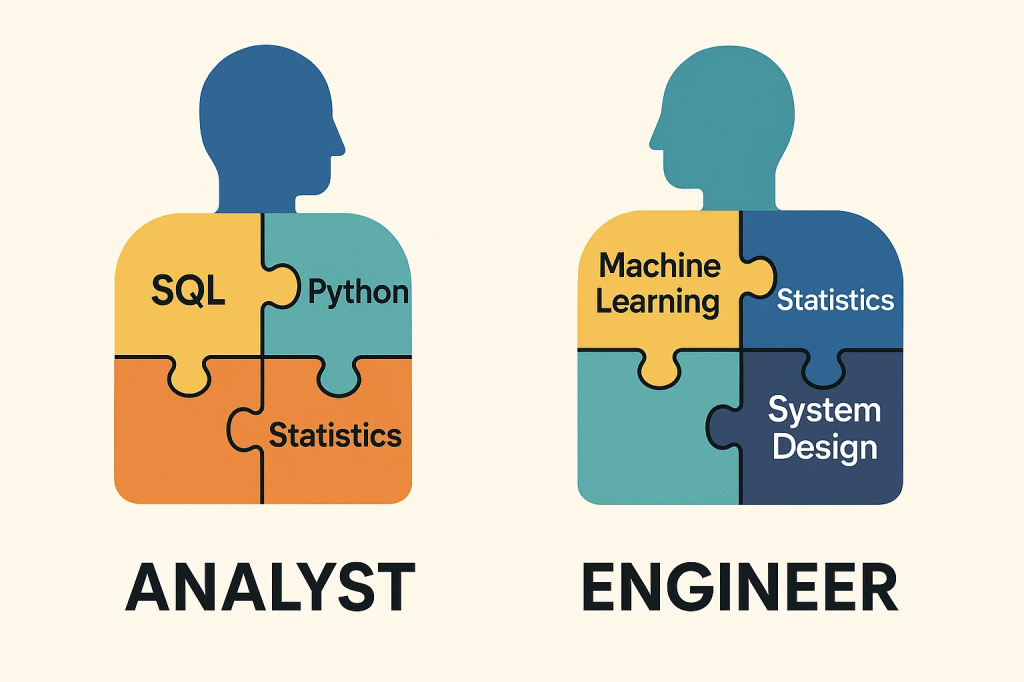
Navigating your first tech job can feel like decoding a sea of similar-sounding titles:
Data Analyst, BI Analyst, Data Engineer, Data Scientist, ML Engineer, Software Engineer.
What do these roles actually do? What skills do they require? And how much do they overlap?
This blog breaks it all down with plain language and a helpful heatmap of skills.
🧭 Role Overview
| Role | Key Responsibilities | Common Tools / Skills |
|---|---|---|
| Data Analyst | Analyze business data, create dashboards, and support decisions | SQL, Excel, Tableau, Python, Statistics |
| BI Analyst | Focus on BI tools, dashboards, and process optimization | Power BI, Looker, SQL, Data Modeling |
| Data Engineer | Build data pipelines, ETL workflows, and manage data infrastructure | Python, SQL, Spark, AWS/GCP, Airflow |
| Data Scientist | Analyze data and build ML models | Python, Pandas, scikit-learn, ML, Statistics |
| ML Engineer | Deploy and scale ML models in production | Python, TensorFlow/PyTorch, MLOps, APIs |
| Software Engineer | Develop apps, systems, and features | Python/Java/C++, Git, REST APIs, System Design |
🧠 Skills Comparison: Where They Overlap (and Don’t)
Instead of a crowded Venn diagram, here’s a cleaner way to visualize how their skill sets align:

- ✅ Python is everywhere — a great first language to learn.
- ✅ SQL is core for Data Analyst and Data Engineer roles.
- ✅ Machine Learning & Statistics matter more for DS/ML roles.
- ✅ System Design, Git, and REST APIs are more unique to Software Engineers.
- ✅ Visualization & Business Tools (Tableau, Power BI) are key for Analysts.
🎯 Which Role Fits You Best?
✔ You might thrive as a Data Analyst / BI Analyst if:
- You enjoy interpreting business trends and making visuals.
- You’re interested in dashboards and reporting tools.
- You’re analytical but not necessarily technical.
✔ You might be a Data Engineer if:
- You like building systems and organizing complex data.
- You’re comfortable with Python and cloud platforms.
- You want to “make the data flow” behind the scenes.
✔ You might want to be a Data Scientist / ML Engineer if:
- You love digging into data and discovering patterns.
- You want to build models that predict and automate.
- You’re into math, stats, and learning algorithms.
✔ You’re likely a Software Engineer if:
- You enjoy building products and writing logic-heavy code.
- You’re more into systems and app development than analytics.
- You want to work on product teams and solve user problems.
🚀 Getting Started: Courses & Projects
| Role | Good First Course | Project Idea |
|---|---|---|
| Data Analyst | Google Data Analytics, SQL for Data Science | Analyze NYC Airbnb data using Tableau |
| Data Engineer | Data Engineering Zoomcamp, AWS/GCP Basics | Build an ETL pipeline using Airflow |
| Data Scientist | Andrew Ng ML Course, Kaggle Competitions | House price prediction model |
| ML Engineer | Deep Learning Specialization, MLOps Zoomcamp | Deploy an image classifier with FastAPI |
| Software Engineer | CS50, System Design Primer, LeetCode | Build a chat app or RESTful API server |
🔑 Final Takeaways
- The lines between these jobs blur — many skills overlap!
- Your first role won’t define your forever path. You can pivot.
- The best way to learn? Do projects, meet mentors, and explore.
🎯 Not sure which role fits you best?
Resumemo analyzes your background, skills, and experience to recommend the most suitable job titles — whether it’s Data Analyst, ML Engineer, or Software Engineer.
💡 Come to Resumemo and discover your hidden strengths.
📌 Tailor your resume. Track your journey. Land the right role.

Leave a comment