Big Pharma meets polite paralysis: a tale of risk-averse “innovation,” PowerPoint loyalty tests, and slow-motion ambition.
1. Innovation Is Our Passion — As Long As It’s Pre-approved, Painfully Safe, and Doesn’t Offend Anyone in Tokyo
We love innovation. We say it. We write it. We bold it on slide 3 of every deck.
But proposing something actually new?
- First, draft a deck.
- Present to three layers of middle managers who only know you by Outlook calendar color.
- Receive feedback like “Interesting — let’s revisit in Q4.”
- Watch it re-emerge six months later under a different name… from someone ten levels above you.
We are an R&D company terrified of risk.
It’s like being a firefighter afraid of smoke.
2. The Cross-Cultural Meltdown Simulator
Welcome to the worst fusion dish you never ordered:
- Japanese hierarchy: where you need your manager’s manager’s blessing to exhale.
- American hustle culture: where Slack replies at 10:37 p.m. are a performance metric.
The result:
A “multinational” company that’s logistically global, emotionally deep-fried in indecision, and spiritually MIA.
You’re told to “take initiative,” but also “loop in Japan HQ.”
Encouraged to “be bold,” but warned “don’t step on toes.”
So we CC everyone and hope someone cracks.
And if you think you can raise your concerns to someone who can actually do something?
Think again.
The hierarchy is so airtight, you’ll rarely meet anyone more than two levels above you — let alone be allowed to speak freely.
Information travels one direction: upward, filtered, softened, and delayed.
By the time your idea reaches decision-makers, it’s no longer yours — and no longer an idea.
It’s not a communication channel.
It’s a corporate game of telephone where the message always dies politely halfway up the chain.
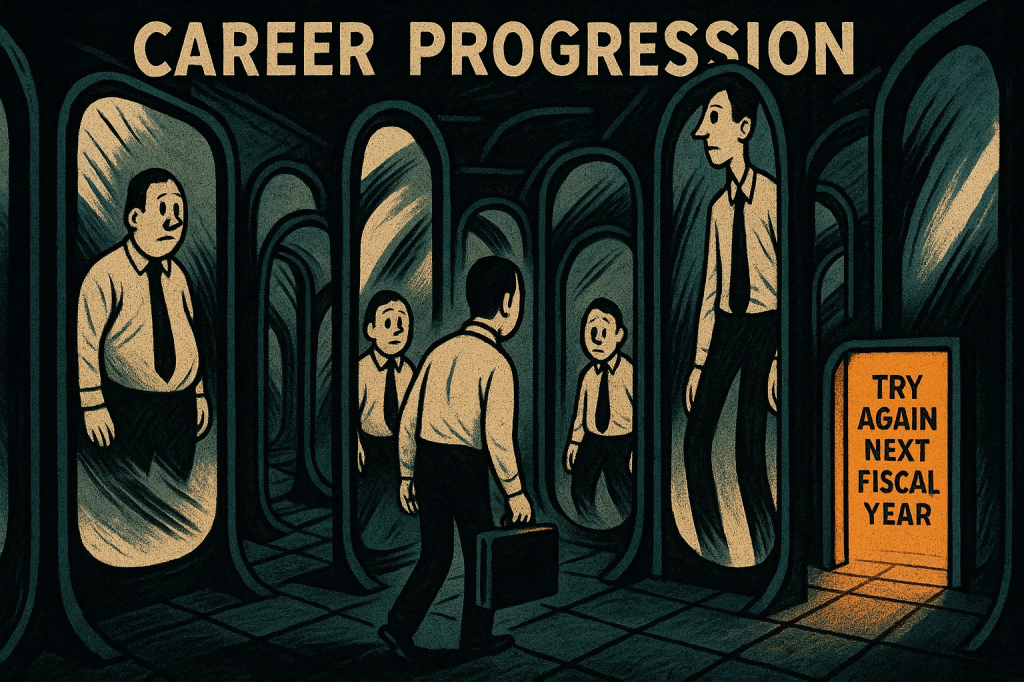
3. Career Progression: A Hunger Game With Kanban Boards
There are 60 people on the team.
There are 2 promotions.
Per year.
To compete, you must:
- Work twice as hard as everyone else.
- Say half as much.
- Smile through the funeral of your own ambition
Promotions go to those who:
- Have “been around.”
- Never corrected a VP’s Excel font choice.
- Attended every optional meeting and stayed visibly awake.
But don’t be the person who shines too brightly.
Original thinking is risky. Visible ambition is dangerous.
They don’t reward standout performers.
They reward the smooth, the silent, the politically frictionless — people whose résumés are just long lists of calendar invites they survived.
It’s not a ladder.
It’s a polite, painfully slow elimination game where the bold quietly self-destruct, and the bland quietly ascend.
4. Feedback Culture: AKA “We Noted Your Pain, Please Format It Differently”
“We welcome honest feedback,” they say.
Translation:
- Be vague enough to ignore.
- Be polite enough to frame.
- Be passive enough to not offend the very system you’re critiquing.
Say something real — like “This structure doesn’t work”?
You’re negative.
Say nothing?
You’re disengaged.
Either way, the culture wins. You lose.

🧪 Join Us!
We’re hiring! Do you love:
- Performing innovation cosplay?
- Navigating 14-person email threads with zero accountability?
- Watching ideas age like dairy?
Then apply today!
Bring your ambition — and we’ll politely euthanize it over the next fiscal year.

Leave a comment